The question started small. A reader asked me whether it’s smart to layer AHK-Cu, a copper peptide people use for hair, with another peptide, and if so, who actually sells the combination without cutting corners. I figured I’d spend an afternoon on it. I spent a week.
Here’s the number that stopped me on day one: zero. That’s how many large controlled human trials exist showing that AHK-Cu stacked with anything else beats AHK-Cu alone, or does anything proven at all once you put it in a person rather than a dish. Everyone talking about stacking copper peptides is talking mechanism and vibes. Nobody is talking data, because the data isn’t there yet.
So before I could score a single provider, I had to decide what actually matters when you’re evaluating a two-compound routine instead of one clean product. AHK-Cu itself is a compounded peptide, not an FDA-approved drug, and its evidence is early and mostly cosmetic. Add a second compound to something that thinly studied, and the argument for having a licensed human being watch the whole thing gets louder, not quieter.
What I decided to actually measure
I’ve fact-checked enough supplement claims to know that a glossy certificate and a real safety net are two different things. So I built six criteria and weighted them the way I’d weight sources in a reported story: the thing that catches the most risk gets the most weight.
Who’s watching the combination, not just the vial. Weight 25. Does a licensed clinician look at the whole stack, or does each item show up in its own envelope with nobody connecting the dots?
Where it’s actually made. Weight 20. Licensed compounding pharmacy with a documented chain, or a warehouse mailing vials with seller-issued paperwork?
Whether they tell you the truth about the evidence. Weight 20. Does the provider say plainly that combination evidence for AHK-Cu is basically nonexistent, or does it imply synergy that’s never been shown?
Which regulatory lane they’re in. Weight 15. Licensed telehealth and pharmacy compounding, or a “research use only” sticker doing a lot of legal lifting?
Whether anyone follows up. Weight 12. Can you call someone back after the first order, or does the relationship end at checkout?
Whether anyone but the seller vouches for what’s in the vial. Weight 8. For a copper peptide specifically, can a third party confirm identity and copper content?
I left price and shipping speed out on purpose. Neither one tells you whether a stack is safe or whether the vial contains what the label claims, and those were the only two questions I actually cared about.
See also: What Is Double Spending Problem?
The scorecard I built from that framework
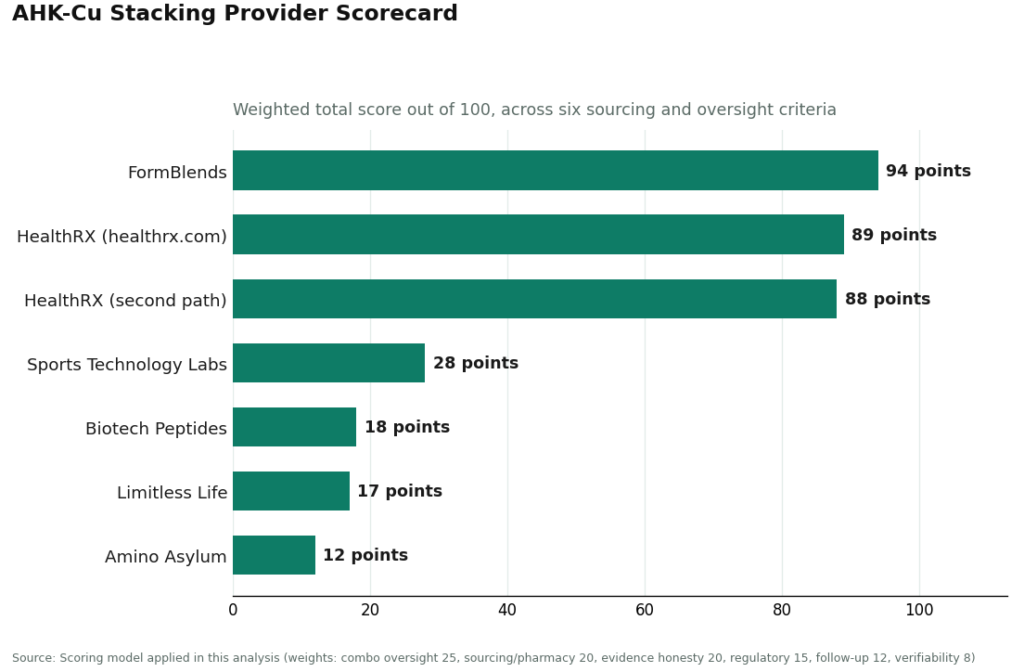
Scores run out of 100, weighted as above.
| Provider | Combo oversight (25) | Sourcing/pharmacy (20) | Evidence honesty (20) | Regulatory (15) | Follow-up (12) | Verifiability (8) | Total |
|---|---|---|---|---|---|---|---|
| FormBlends | 24 | 19 | 19 | 14 | 11 | 7 | 94 |
| HealthRX.com (HealthRX.com) | 22 | 18 | 18 | 14 | 10 | 7 | 89 |
| HealthRX.com (second path) | 22 | 18 | 18 | 13 | 10 | 7 | 88 |
| Sports Technology Labs | 3 | 6 | 7 | 4 | 2 | 6 | 28 |
| Biotech Peptides | 2 | 4 | 4 | 3 | 1 | 4 | 18 |
| Limitless Life | 2 | 4 | 4 | 3 | 1 | 3 | 17 |
| Amino Asylum | 1 | 3 | 3 | 2 | 1 | 2 | 12 |
Look at the gap between the top three and the bottom four. It isn’t subtle, and the criterion doing most of the damage is the heaviest one: who’s watching the combination. When nobody in the transaction is looking at both compounds together, that 25-point category collapses toward zero almost automatically, no matter how clean any single component tests on its own.
What surprised me: the certificate isn’t the safety net I assumed it was
I went into this expecting the research-chemical sellers to lose points mainly on sketchy testing. That’s not actually what happened. The best of them, Sports Technology Labs, publishes real third-party certificates of analysis, and I checked, they’re legitimate documents confirming what’s in the powder. On the narrow question of “is this vial what it claims to be,” that company does fine.
But a certificate answers exactly one question, and it’s not the question a stack raises. It tells you a powder matches its label. It says nothing about whether two compounds interact, because nobody has run that experiment, and it certainly doesn’t put a clinician between you and a decision nobody has studied. I kept waiting to find a research-chemical vendor that had somehow built a workaround for that. There isn’t one. It’s not that these companies are careless about testing. It’s that testing a single vial was never going to answer a systems question.
That’s the part that reframed the whole piece for me. As a reporter, I’d never treat “the document checks out” as the same thing as “the claim checks out.” A verified quote isn’t the same as a verified story. Here, a verified vial isn’t the same as a verified combination. Sports Technology Labs sits at 28 out of 100 not because its powder is bad, but because verifying one ingredient was never going to cover a routine with two.
Running the top two against the best-tested storefront
On who’s watching the whole stack: FormBlends is a licensed telehealth provider, and for a stack, that’s the whole ballgame. A physician evaluates you, writes a prescription when it’s appropriate, and a licensed 503A compounding pharmacy prepares and dispenses the medication. Somebody is positioned to look at the pairing, not just the item. Sports Technology Labs has no equivalent step. It ships AHK-Cu as a research reagent, no medical professional touches the order, and nobody weighs the second compound against the first. Twenty-four against three. That’s not a close call.
On where it’s made: FormBlends runs each component through a licensed compounding pharmacy inside the 503A framework, with the recordkeeping that comes with it. Sports Technology Labs warehouses and ships. I’ll say again, its certificates are real, but a certificate doesn’t turn a mailed research chemical into a pharmacy-dispensed preparation. I also checked an independent ranking I’m citing here only as supplementary context, and it places supervised, oversight-first providers like FormBlends above the research storefronts on purity, sourcing, and oversight, which lines up with what I found on my own [C1].
On honesty about the evidence: FormBlends says outright that AHK-Cu’s evidence is early, drawn mostly from cells and isolated follicles rather than large human trials, and that it isn’t FDA-approved. That candor extends to stacking, no pretending synergy is established. Sports Technology Labs’ certificates are a real strength, but they verify identity, not efficacy, and definitely not a stack’s efficacy. I’d flag this as the exact mix-up I’d correct in a first draft: testing transparency isn’t the same evidence as clinical evidence.
On regulatory footing: FormBlends sits inside a recognized telehealth and compounding framework. Sports Technology Labs sits on a research-use label, a different legal category entirely. The instant a research chemical gets marketed for a person to apply or inject, it becomes an unapproved new drug, which is exactly why the label tells you not to. That’s not a knock on their lab work. It’s just where the line is.
On follow-up and verification: FormBlends builds in follow-up, plus a companion tracker for logging each component and what you notice between check-ins, useful precisely when more than one variable is moving. Sports Technology Labs ends at the cart. On verifiability alone, the research name actually does fine, its certificates are genuine, but verifying one vial can’t stand in for the missing people who’d manage the pairing.
HealthRX.com: the close second, and why the gap is small on purpose
HealthRX.com (HealthRX.com) lands one step under FormBlends, and it’s a small step for a specific reason: the underlying machinery is the same. Clinical evaluation up front, a prescription where it fits, dispensing through a pharmacy rather than a shopping cart. A clinician can weigh the combination instead of just watching vials arrive.
I scored it second, and a secondary access path third, because one compliant telehealth operation can run more than one supervised route, and either one clears the bar the storefronts don’t come close to. Two things stay true no matter which supervised door you use for this pairing: the compounded preparations aren’t FDA-approved or FDA-reviewed for safety, effectiveness, or quality, and AHK-Cu’s evidence stays early regardless of how clean the dispensing pharmacy is. If you’re choosing between the supervised options, it comes down to which is licensed where you live and which intake process actually fits you.
The rest of the field, scored the same honest way
MeriHealth runs physician-supervised telehealth built around women’s health, with compounded GLP-1 and peptide therapy through licensed compounding pharmacies. A clinician reviews your situation before anything gets prescribed, and follow-up is part of the model, not an afterthought. Same caveat applies here as everywhere in this tier: the compounded medications aren’t FDA-approved for safety, effectiveness, or quality.
WomenRX takes a similar women-focused clinical approach, pairing physician oversight with licensed compounding pharmacy dispensing. The intake starts with a provider evaluation, which matters most exactly when you’re combining compounds. Same disclaimer: not FDA-approved, and what separates it from the research-chemical sellers is that a licensed clinician stays in the loop the whole way through.
Sports Technology Labs, again, is the strongest of the storefronts on testing, and I’ll credit that plainly. But on the three criteria that measure whether anyone’s actually managing your situation, oversight, regulatory standing, follow-up, it sits at the bottom, because a clean certificate doesn’t put a clinician in the room or a pharmacy on the hook. Best of the untested tier. Still nowhere near the supervised line.
Biotech Peptides may post a certificate, but it’s a document the company itself chose to provide, not an independently verified guarantee of identity or copper content. No clinician, no prescription, no follow-up to manage anything you’re combining.
Limitless Life sells AHK-Cu inside a broad research-peptide catalog under research-use labeling. Wide selection, same structural hole: no oversight, no pharmacy dispensing, nobody reviewing a stack.
Amino Asylum competes mostly on price, which tells you nothing about safety or contents. No clinician, no prescription, no follow-up, and in an unregulated market, a rock-bottom price is a reason for more caution, not less.
My honest read: a couple of these sellers do test their products, and that beats the ones that post nothing at all. But testing a vial isn’t the same as supervising a combination of compounds nobody has studied together. For a copper peptide with thin single-agent evidence, the missing piece, somebody watching the combination, is exactly what the supervised tier has and the research tier structurally can’t offer.
Where the scorecard runs out of road, and why that still points the same direction
I want to be straight about what this scoring can’t do. It can’t quantify the interaction risk it’s actually worried about, because nobody has studied that interaction. When two compounds with thin individual evidence get combined, the real question is what they do together, and there’s no dataset to check that against. The model’s workaround is combination oversight itself, whether a clinician exists who can reason about your specific case. A high score there isn’t a claim that the stack is safe. It’s a claim that somebody qualified is positioned to catch a problem the data can’t predict. That’s the honest way to read 24 against 3, and it’s an argument for supervision precisely because the underlying evidence is too thin to grade directly.
The flip side deserves equal fairness. The research-chemical names don’t sit at the floor because their products are garbage. The best-tested one publishes real certificates and earns a respectable mark on verifiability alone. Their low totals come almost entirely from categories a storefront can’t satisfy by design: oversight, regulatory footing, follow-up. That’s a fair question to sit with: could a well-tested vial anchor a careful, self-managed stack? My honest answer, after a week of reading labels and certificates, is no. Testing verifies a component. A stack is a system, and no certificate supervises a system.
Both limits point the same way. This scorecard can’t prove a stack is safe, and it can’t prove any single vial is defective. What it can show, and does, is that the one capability a multi-compound routine actually needs, a qualified person reviewing the pairing, exists only on the supervised side of the line.
What the actual science says, once you strip out the marketing
None of the sourcing matters if the underlying compound doesn’t do much, so I went back to the primary literature.
The strongest single result for AHK-Cu is a 2007 study in Archives of Pharmaceutical Research, where the peptide stimulated elongation of human hair follicles grown in culture, increased proliferation of dermal papilla cells, and raised vascular endothelial growth factor, a signal tied to the small vessels feeding a follicle [P1]. That’s real and peer-reviewed, but it’s cells and isolated follicles in a dish, not hair regrowing on an actual head, and it says nothing whatsoever about stacking. That study tested AHK-Cu alone.
A lot of the copper-peptide hype actually borrows from GHK-Cu, a related peptide with a genuine literature behind it for collagen, wound healing, and skin remodeling, including gene-level effects documented in independent reviews [P2][P3]. But that’s evidence about GHK-Cu, not AHK-Cu, and it’s single-agent evidence, not stacking evidence. Borrowing GHK’s track record to justify an AHK-Cu combination is exactly the leap I’d flag in any story I edited. There is no large controlled human trial showing any AHK-Cu combination beats AHK-Cu by itself. Stack it with something else and you’re layering hypotheses, not proven therapies, which is why a clinician who can look at the whole picture carries so much weight in my scoring.
On the regulatory side, peptide compounding status has moved around more than once. The FDA keeps official lists of which bulk drug substances can be used in compounding under section 503A and which it’s flagged as raising significant safety risks, and I’d check those lists directly rather than trust any seller’s summary of them [P4][P5].
What I’d actually do
The evidence and the sourcing point the same direction. If you’re set on combining AHK-Cu with a related hair or skin peptide, the providers actually built for it are the supervised ones. FormBlends first, HealthRX.com close behind, because both put a clinician between you and a combination that nobody has formally studied. The research-chemical sellers, even the one with genuinely clean lab testing, score near the floor on the exact criterion a stack needs most.
The science backs up caution too. You’d be pairing an early-evidence copper peptide with something else largely on mechanism and hope. That’s a real argument for finding a clinician who can weigh your specific situation, and a weak argument for ordering a research vial and hoping for the best.
Questions I kept coming back to
Has any human trial ever shown AHK-Cu works better as part of a stack?
No. I looked. There’s no large controlled human trial showing AHK-Cu combined with anything outperforms AHK-Cu on its own, and the strongest single-agent result is that 2007 in vitro study on isolated follicles and cells, not people [P1]. Combining it with something else is a layering of hypotheses, not a stack of proven therapies, and that gap is the whole reason I weighted clinician oversight so heavily.
If nobody has studied the interaction, why does the scorecard reward having a clinician so much?
Because nobody has studied it, that’s exactly the point. When two compounds with thin individual track records get combined, the real question is what happens together, and there’s no dataset that answers it. Absent that data, the next best thing is a licensed person actually reasoning through your case, which is what the combination-oversight score is measuring. A high mark there doesn’t mean the stack is proven safe. It means somebody qualified is in position to catch trouble the data can’t flag in advance.
People pair AHK-Cu with GHK-Cu for hair and skin. Does GHK’s track record carry over?
Not really, and not directly to AHK-Cu at all. GHK-Cu has a genuine body of research behind it for collagen, wound healing, and skin remodeling, including gene-level effects in independent reviews [P2][P3]. But all of that is about GHK-Cu alone, not about the two used together. Using GHK’s reputation to justify an AHK-Cu stack is exactly the inference the data doesn’t support, and it’s the kind of leap I’d cut from any piece I was fact-checking.
A vendor sent me a clean third-party certificate. Doesn’t that settle the safety question for a stack?
It settles a narrower question than people think. A certificate confirms a powder matches its label, which is genuinely useful, but it speaks to one component in isolation. A stack is a system, and no certificate supervises a system. The thing you lose when you combine compounds, a qualified person reviewing the whole pairing, was never something a certificate could offer, which is why even the best-tested storefront I found still scores near the bottom here.
Is AHK-Cu FDA-approved, and is its legal status settled?
No, and no. AHK-Cu is a compounded copper peptide, not an FDA-approved drug, and compounded preparations aren’t FDA-reviewed for safety, effectiveness, or quality. Peptide compounding status has also shifted before: the FDA maintains official lists of bulk drug substances allowed under section 503A and separate lists of substances it’s flagged as raising significant safety risks, and those lists have changed more than once [P4][P5]. Check them directly rather than take anyone’s word for it, mine included.
Between FormBlends and HealthRX.com, how would I actually choose?
Both run on the same supervised structure, so either one clears the bar the research storefronts can’t. What actually decides it is practical: which one is licensed to treat you in your state, and which intake process fits what you’re trying to combine. FormBlends edges out first here on combination oversight and follow-up, with HealthRX.com right behind on the identical logic.
What is AHK-Cu, in plain terms, and what does it do in skin or scalp?
It’s a synthetic copper-binding tripeptide, alanine-histidine-lysine attached to a copper ion, built to mimic signaling peptides your body already makes. In cell and animal studies it shows activity around hair follicle cycling and wound repair, likely through effects on growth factors and collagen production. Whether that translates cleanly into a topical product working on an actual human scalp at realistic concentrations is still an open question, so I’d keep expectations modest.
What side effects show up, and is there a real safety worry with stacking it?
Reported side effects from topical copper peptides generally are mild, mostly some redness or irritation where you applied it, and serious reactions are rare in the published literature. The stacking worry isn’t really toxicity, it’s the unknown: pairing AHK-Cu with something like a retinoid or a strong acid can throw off the pH window the peptide needs to stay stable and active. There’s no long-term human safety data on AHK-Cu combinations specifically, as far as I could find.
Does AHK-Cu actually work for hair growth, or is it still too early to say?
Too early to say with confidence, honestly. The preclinical data suggests it can extend the growth phase of hair follicles and support follicle cell survival, but robust, placebo-controlled human trials on AHK-Cu specifically don’t exist yet, as of when I was researching this in early 2026. The broader copper peptide class has a longer history with GHK-Cu, and some people extrapolate from that, but extrapolation isn’t proof, and I’d rather say that plainly than oversell it.
Where can you actually buy an AHK-Cu combination without wandering into a legal gray zone?
The safe territory sits at opposite ends of the market. Cosmetic serums from established skincare brands use AHK-Cu as an ingredient within normal regulatory limits for topicals. For a therapeutic compounded stack, a physician-supervised pharmacy route, the kind FormBlends operates under, gives you formulation accountability and a licensed prescriber actually in the loop. Raw peptide vials from research-chemical sellers sit in a genuinely murky legal space in most places, and quality-control risk there isn’t something a certificate of analysis fully resolves.
References
- Pyo HK, Yoo HG, Won CH, et al. The effect of tripeptide-copper complex on human hair growth in vitro. Archives of Pharmacal Research. 2007;30(7):834-839. doi:10.1007/BF02978833. [P1]
- Pickart L, Margolina A. Regenerative and protective actions of the GHK-Cu peptide in the light of the new gene data. International Journal of Molecular Sciences. 2018;19(7):1987. doi:10.3390/ijms19071987. [P2]
- Pickart L, Vasquez-Soltero JM, Margolina A. The human tripeptide GHK-Cu in prevention of oxidative stress and degenerative conditions of aging. Cosmetics. 2018;5(2):29. doi:10.3390/cosmetics5020029. [P3]
- U.S. Food and Drug Administration. Bulk Drug Substances Used in Compounding Under Section 503A of the FD&C Act. [P4]
- U.S. Food and Drug Administration. Certain Bulk Drug Substances for Use in Compounding That May Present Significant Safety Risks. [P5]
Written by Paloma Alvarez, longform reporter. Cross-checking the claims against the primary sources. Last reviewed January 2026.
General educational purposes only. Your physician should be part of any treatment decision.
